Most homeowners arrive with the order reversed. They picture the finished surface first and treat heated driveway installation in Lincoln, MA as an upgrade that can be added later, the way a light fixture gets swapped out. A snowmelt system does not work that way. It lives underneath the pavers, inside the same excavation and the same base, so the decision has to be made while the driveway is still a drawing.
That sequencing is where our design conversations spend the most time. For over two decades Premier Pavers & Hardscape Co. has been designing and building outdoor spaces across Eastern Massachusetts, with more than one million square feet of pavers installed. What that has taught us is that the snowmelt question is really four questions, and all four get answered before anyone orders a pallet of pavers.
This article walks through what gets settled on paper: where the heated zones go, which system type suits the property, how deep the build-up runs, and where the sensor and controls sit. None of it photographs well, but all of it sets the price you pay once and the performance you live with for the next twenty winters.
Related: 10 Landscape Design Ideas for a Luxurious Outdoor Kitchen Area in Sudbury and Winchester, MA
Why Is a Heated Driveway Designed at the Same Moment the Driveway Is?
A heated driveway is designed at the same moment as the driveway because the snowmelt system is buried inside the same excavation and base. Electric cable or hydronic tubing sits in or just under the setting bed, above the compacted base and below the pavers. Reaching that depth on an existing surface means lifting the pavers and opening the base, so in practice the old driveway comes out.
That single fact reshapes most consultations. Homeowners who expect a surface-mounted product are surprised by the scope, and reasonably so, because the work is a full driveway replacement with a heating system built into it. The upside is real: you pay for excavation, base, edge restraint and pavers once instead of twice.
So the honest framing is this. If your driveway is due for rebuilding anyway, that rebuild is the moment to decide about heat. If it is not due, the cost of heat carries the cost of a new driveway with it, and that belongs on the table at the start rather than in the third meeting.
What Do We Map Before Setting the Snowmelt Zone Layout?
Before setting the snowmelt zone layout, we map where cars stop, where people walk, which stretch of grade makes a car hesitate on an icy morning, and where melt water will drain.
Our designer walks the property and marks how it gets used in February, and those marks define the heated area rather than the property line. Heated square footage is the single largest cost driver in the project, so choosing it carefully is worth more than any other decision on the page.
We also record pitch and drainage direction, because melt water has to leave the surface. A heated zone that drains onto a cold apron builds an ice shelf at the bottom of the run. The layout has to carry water somewhere it keeps moving, which usually means the heated area extends slightly past the point where you would instinctively stop it.
Which Driveway Areas Usually Earn the Heat?
The garage approach, the apron where the driveway meets the street, the walk to the front door and the steepest section of grade usually earn the heat.
On long runs, some properties heat only the tire tracks and the turning area rather than the full width, which cuts operating cost while keeping the car moving. Our paver driveway work often pairs a fully heated apron with tire-track zones further out.
Which Driveway Areas Usually Stay Unheated?
Guest parking bays, wide shoulders and flat stretches a plow clears without difficulty usually stay unheated. Heating ground that a plow already handles well adds cost with little return. We would rather put that budget into a deeper base or a better-grade paver than into square footage you would not miss on a snowy morning.
What Does the Site Itself Decide Before the Snowmelt System Is Chosen?
The site decides heated zone width, excavation depth, system type and staging before any design preference is expressed. A long, steep run with a tight garage entry argues for a wider heated zone than a flat suburban apron, because a car losing traction on a grade has nowhere useful to go. Stone ledge under the subgrade, common enough in this part of Massachusetts, changes excavation depth and cost on its own.
The house has a say too. Hydronic needs boiler capacity and somewhere to hang a manifold, so a crowded mechanical room or an older boiler already at its limit pushes a project toward electric or toward a dedicated snowmelt boiler. Electric needs panel capacity and a service that carries the load, which on some older homes means an upgrade priced into the project rather than discovered halfway through.
Access matters as well. Excavation spoil, base material and pallets of pavers all move by truck, and a narrow entry or a low tree canopy changes staging, equipment size and schedule. Our designer settles these constraints during the site visit so the proposal you read reflects your property rather than a standard template.
How Do We Choose Between Hydronic and Electric Snowmelt?
We choose between hydronic and electric snowmelt by heated area and operating cost rather than preference. Our team installs both: electric uses resistance cable laid in the bedding layer on a dedicated circuit, and hydronic circulates a heated glycol and water mix through loops of flexible tubing fed by a boiler and a manifold.
Both melt snow reliably. They differ in what they cost to install, what they cost to run, and what they ask of the house itself.
What Makes Hydronic the Usual Answer on a Full Driveway?
Hydronic is the usual answer on a full driveway because once heated area passes a few hundred square feet, operating cost dominates the math, and hydronic is markedly cheaper per square foot to run.
It also needs somewhere to live: a boiler, an expansion tank, a pump and a manifold, plus wall space in the basement or mechanical room. Loop lengths are capped, so the layout gets divided into balanced circuits during design rather than during installation.
When Does Electric Snowmelt Make More Sense?
Electric snowmelt makes more sense on small, high-value areas such as an entry landing, a set of steps, a short apron or a single pair of tire tracks. There is no boiler and no mechanical room requirement, and the installation window is shorter, though the electrical service has to support the load, which is worth confirming early with your electrician.
Operating cost is the number homeowners underestimate. A snowmelt system draws energy only during a storm and for a short run-on period afterward, but a large electric zone through a heavy New England winter reads clearly on a utility bill, while a hydronic zone of the same size does not.
We put estimated seasonal operating cost in writing during design so the comparison sits on paper instead of in memory.
Related: Why Hardscape Is the Ultimate Upgrade for Your Outdoor Living Space
What Changes in the Base and Build-Up Under a Heated Driveway?
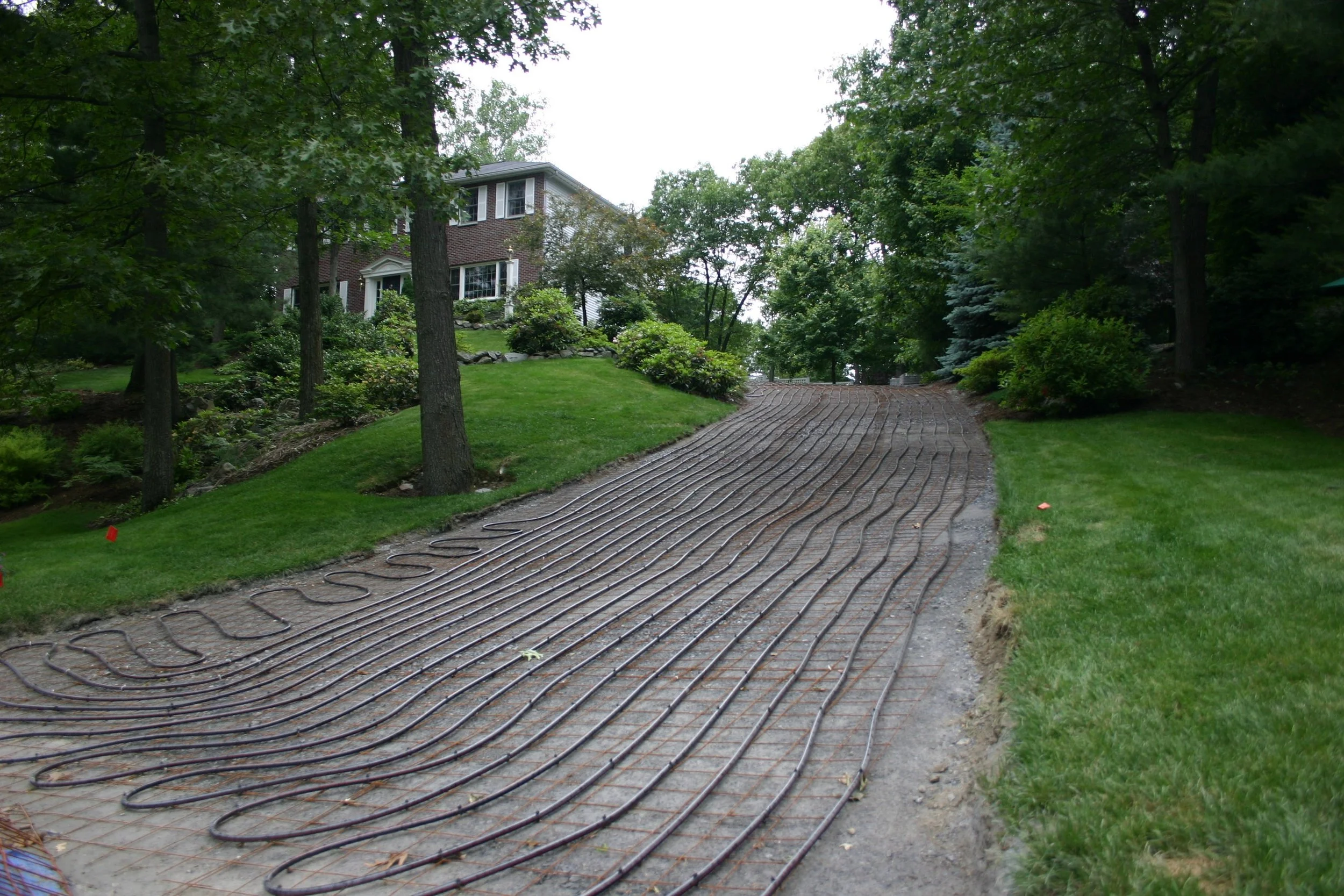
A heated driveway adds a layer and depth to the base, along with a stricter grading plan for melt water. A standard paver driveway in New England is built on compacted aggregate placed in lifts, then a bedding layer, then pavers. In a heated build, hydronic tubing is commonly tied to reinforcing mesh over a concrete slab with bedding and pavers above it, while electric cable more often sits directly in the bedding course.
That means deeper excavation and more material than a cold driveway of the same size. It also means the grading plan gets stricter, because a heated surface produces water in the middle of winter and that water has to reach somewhere it can go. Edge drains, a catch basin, or a graded escape toward a lower area get designed in at this stage.
Frost depth, subgrade condition and compaction in lifts matter more on a heated build than a cold one, because a settlement crack in a heated slab is expensive to open up later. This is the part of the scope worth reading closely in any proposal you receive, and the part a low bid tends to thin out.
Edge detail deserves a mention here. A heated driveway cycles through freeze and thaw more often than a cold one, and the perimeter takes that movement first, so edge restraint and the jointing product get specified with that cycling in mind rather than picked at the end of the job.
Where Do the Snowmelt Sensor and Control Panel Go?
The snowmelt sensor goes in a pavement spot that represents the heated zone, and the control panel and conduit get placed during design, before the base is compacted. The standard arrangement is a pavement-mounted sensor that reads surface temperature and moisture together, so the system fires during a storm and idles the rest of the time rather than relying on a homeowner flipping a switch at midnight.
Sensor placement is a design decision, not a field decision. It belongs out of the garage overhang, away from downspout splash, and clear of the bay where a car parks over it. Put it in the wrong place and the system either runs when it should not or waits too long to start.
The control panel, conduit runs and power feed follow the same rule. Sleeves and conduit have to be set before the base is compacted, which is why the electrical layout is finished during design rather than discovered on installation day.
One more placement note. The sensor reads only the surface it sits in, so a zone that spans a shaded north side and a sun-exposed apron may warrant a second sensor or a zone split. Sun and shade across one driveway differ by several degrees, which is enough to leave one end wet and the other glazed with ice.
What Do Snowmelt Controls Let You Set?
Snowmelt controls let you set the slab setpoint, ambient temperature limits, and a run-on period after the storm ends so the surface dries instead of refreezing. Most systems also support a manual override for an ice event with no snowfall. Our team walks through these settings at commissioning and again after your first real storm.
What Does the Build Sequence Look Like on a Lincoln, MA Property?
Design and layout approval come first, with heated zones, system type, sensor location and drainage fixed on paper. Utility marks and permitting follow. Then excavation, sleeving, base in compacted lifts, slab or bedding, and the tubing or cable layout, which gets pressure tested or meter tested before anything covers it.
Pavers, edge restraint and joint stabilization come next, then commissioning with the heating contractor and a live test. A typical residential heated driveway runs several weeks on site, with the exact figure depending on square footage, access and grade. You get one project manager through all of it, so the heating trade, the paver crew and the electrician are coordinated by us rather than by you.
Timing matters in New England. A system that should be live for the first storm needs to be designed in late summer or early fall, because permitting, material lead times and a multi-week build do not compress well. Properties that start the conversation in October are usually planning for the following winter.
Expect a written construction calendar with the proposal. Dated milestones for excavation, base, heating layout, paving and commissioning give you something concrete to hold us to, and they are the clearest signal that a contractor has sequenced the trades rather than hoping they line up on their own.
Plan Your Heated Driveway Installation in Lincoln, MA Around the Rebuild
If a driveway rebuild is on your list for the next year or two, that is the window to decide about heat, and our team will show you the zone layout and an honest cost picture before you commit to anything.
Premier Pavers & Hardscape Co. designs and builds the driveway and the snowmelt system as one scope, with one point of contact for the whole project, across Lincoln and the surrounding Eastern Massachusetts towns. We will walk the property with you and put real numbers to it.
Contact Premier Pavers & Hardscape Co. to schedule a heated driveway consultation.
In Summary
What does adding a snowmelt system to an existing paver driveway involve?
Adding a snowmelt system to an existing paver driveway involves lifting the surface and opening the base, because the heating layer sits below the pavers and inside the base. That amounts to a rebuild, so the sensible moment to decide is when the driveway is due for replacement anyway.
How long does heated driveway installation take in Lincoln, MA?
Most residential projects run several weeks on site once work begins, and design, permitting and material lead time ahead of that often add a month or more. Access, grade and heated square footage move the figure in either direction.
How does phasing work for a heated driveway?
A heated driveway phases on the paved side only, because a heated zone cannot be extended later without opening that section again. We would rather set the full zone layout up front and build the heated portion in a single pass.
Which towns does Premier Pavers & Hardscape Co. install heated driveways in?
Premier Pavers & Hardscape Co. installs heated driveways across Eastern Massachusetts, including Arlington, Belmont, Brookline, Cambridge, Newton and Wellesley. Projects in those towns follow the same design sequence described here.
Related: How Your Lincoln, MA, Driveway Contractor Plans for Winter Starting This Summer